Tuesday, 15 December 2015

Verbier Night Race - the local 'skimo' race

Skimo, or Ski Mountaineering is a growing sport with more growth in recent years than alpine skiing.  Year on year this is noticeable in the mountains around Verbier as more people take to walking up the pistes, it is featured more frequently in 'Verbier Life' and people look to escape the hustle and bustle of the ski resort; often in search of the very reason some come on holiday here, for the alpine air, some good skiing, to relax and stay fit and healthy.  Like most sports there is also a competitive side...

ISMF individual world cup skimo race start (ISMF image)

Many resorts across the Alps (and increasingly in North America) hold skimo competitions annually.  These normally fall into a category, most local races being Vertical / Individual, and having an elite/popular entry:

Vertical - A race involved uphill only often with 1000m ascent, normally 30mins to two hours
Individual - Uphill and downhill, usually including a bootpack too, often a several hours long
Sprint - a very quick 'sprinting' race, think minutes not hours
Team - In teams of two or three, sometimes over multiple days


Onto the local race then...
Verbier night race flyer

Normally held during the first two weeks of December, the Verbier Night Race/Trophee Verbier Sport Plus race is a vertical night race from Carrefour to Attelas with 962m of ascent over 4.24km, and one of the first races in the calendar.  I first entered the race during my first ski season here six years ago (when there was only the elite category!) and it has changed a great deal since.

Six years ago only a handful of amateur competitors were in skimo suits with super lightweight gear, now, despite owning lighter boots and Dynafit bindings, a significant proportion of the field were on racing skis, boots and in specific skimo 'onesies'... and that's in the popular race!
Racers on their way to Attelas (screenshot from Verbier WebTV)

Not one to be discouraged, at 6pm on the 12th December I found myself on the startline warming up in my normal ski touring softshell outfit!  At 6:25pm over 150 competitors were in the starting box rearing to go.  The start gun went at 6:30pm and we all raced up the first steep hill (a black run!) towards Attelas.

Ski poles are flying everywhere and you power straight up the hill trying to get in a good place to avoid having to overtake others later on.  This spurt of speed combined with the effort of avoiding everyone else can easily send your heart into overdrive!  I was definitely at the top end of my sustainable pace but soon broke into a good rhythm.  The first 30 minutes passed quickly and I was on course to make the race in 75 minutes.  At the half way mark I struggled to keep plugging away at the same pace and around ten people passed me.  My mind wandered from thinking of nothing to trying to justify my slowness, blaming it on my equipment weight, lack of acclimitisation, and the fact that I had just finished seven days of ski school training and had very tired legs!  This, of course, was utter nonsense, I had been in the alps for ten days, and I could have gone faster if I was fitter (I was pretty tired though)!  It was a beautiful night and looking back down the course you could see a constant stream of headtorches looking like reflections of the numerous stars in the sky.  The next 20 minutes took forever, despite the nicer terrain.

Eventually I caught myself and managed to find enough reserve to keep going, the easier slope angles allowed me to speed up a bit, increasing the gap behind me so I could no longer hear the scrap of skins of other competitors closing in on me.  At 1hr 20mins 33secs it was over, I was greeted by a cup of marche tea, a huge plate of spaghetti and my bag full of warm clothes that was carried to the top in the piste basher for me.
I don't think I can warrant a skimo suit (yet!) but maybe some specific race trousers so my nice windstopper ones don't get holes in them from the safety pins!

It was great fun and interesting to see where my fitness was at the beginning of the ski season and I was pleased to come 59th out of 131 popular entries, and around 7th lady.
https://www.mso-chrono.ch/results/553-verbier-night-race/4053/categories#populaire-dames-et-hommes


To finish my post I thought I would just write a comparison of what I competed in against what the majority of racers used followed by some top tips:
My skimo race / normal skimo setup

My Setup (I like to think it is a reasonably light but functional normal alpine touring setup!0
Skis: Dynafit Mustagh ata superlights - 1255g per ski
Bindings: Dynafit TLT Verticals - 500g per binding plus brakes
Skins: G3 Alpinist skins - 250g per skin
Boots: Dynafit TLT 6 CLs - 1020g per boot
Clothing: thin merino thermal, windproof top with insulation on the core, softshell trousers, headband, thin gloves, 300ml of water in a compressible bottle in my pocket! no rucksack needed

Equipment weight total: 6050g

Amateur racing setup (this is for an good weight:price ratio, not the lightest available!)
Skis: most lightweight ones are around 700g per ski
Bindings: now around 200g per binding
Skins: around 150g per skin
Boots: 800g per boot
Clothing: skimo racing suit 

Equipment weight total: 3700g
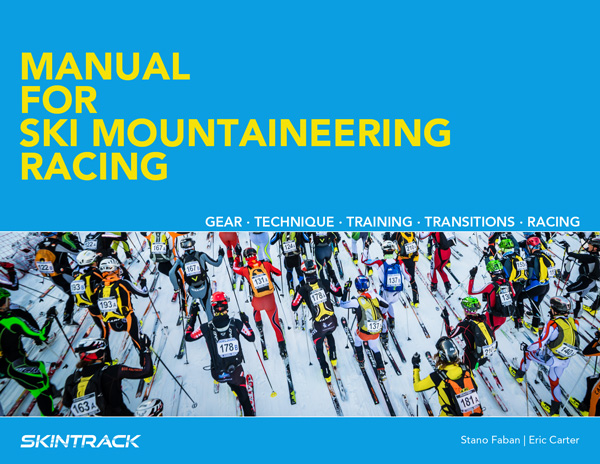
I think this is one the only Skimo manual in English at the moment, available on Skintrack's website

Top tips if you fancy doing a race for fun

  • Although more people are buying fancy gear, plenty of people race on what they have already own including Marker Bindings and 'Fat' Skis!
  • Pace yourself
  • Avoid the ski poles hitting you in the face at the start by placing yourself strategically at the back away from the keener competitors!
  • Enjoy it
  • Book your place early, normally you get a small discount and it means you have to race!
  • Pack an entire change of clothes for your drop bag including thermals and underwear or you can find yourself getting too cold at the end of the race
  • Stretch before eating at the end of the race or you might not be able to stand up from the table!
  • Get a good headtorch for nightraces so you can enjoy the ski back down.

Monday, 14 September 2015

My first foray into the world of Jam making; Damson Jam

I had noticed the numerous apple trees at work but had never realised there were some damson trees in the orchard until last week.  The proliferation of wasps drew me to the plum trees were I found a feast of greengage, plum, damson and pear trees.  Almost no one was picking the fruit and huge quantities of it were going to waste so I picked a bag full in my evening break and began googling recipes.
It's very important to taste your jam!

Damson's are not as sweet and appetising raw as they are cooked or processed.  The most popular recipes were Damson cheese, jam, gin and brandy.  Having just made 3 jars of Spiced Apple Chutney to accompany cheese I didn't really fancy a Damson Cheese, so jam it was.

1.5kg of Damsons (with stones)
1.2kg of Sugar (I used granulated as it is cheaper and this was not a problem at all)
200ml water
 
Easy...
 
First off, put a small plate in the freezer and get your jam jars ready (see the bottom for sterilizing them.

De Stoning the Damsons
 
Ruling out the, boil the fruit to get the stones out, then miss one because you always do, and crack my tooth, I opted for cutting the stones out.  The first ten went well and then it was suggested that I should just squeeze them out - this was infinitely quicker and easier.  I can't think why more recipes don't suggest it!
I added the water to the stones to get that extra bit of juice out
 
After this simmer the fruit with the water then add the sugar and let it dissolve.  A good check is to put some of the back of your wooden spoon and see if any sugar granules are on it.

Stirring the sugar into the fruit


Checking the sugar has all dissolved (in the picture the 'grainy' looking bits are actually small air bubbles on the spoon, so double check it by tasting it!
Then let it start boiling for over ten minutes - you can feel it getting slightly thicker and it will reduce about 1/3 or so in volume.  Get the saucer out of the freezer put some jam on it and stick it back in the freezer.  When the 'saucer jam' is cool prod it with a finger to see if it has set or not.  If it hasn't set give it another five minutes and repeat.  (I was quite unsure about when it would be ready, so I didn't boil it that strongly to start with, and it took around 25minutes of boiling in the end).

Stirring the Jam constantly whilst it is boiling
 
Once ready let it cool off the hob for 10 minutes and then pour into your jars (a ladle is handy for this)
 

Doing the wrinkle test - another good excuse to eat more jam!

 
Then eat it - although it does give you quite a sugar high if you eat too much!


Doing up the jam jars - note the oven glove, they were super hot


Note on sterilizing jam jars:
I now have a collection of Kilner jars but still reuse some old jam jars.  Both jars work, however the Kilner type jars are worth the investment if you will be doing lots of jam and chutney making.  Wash them with soapy water and then put them in the oven at 180degrees.

Sunday, 6 September 2015

The Salomon Glencoe Skyline Race - my first ultra attempt

That's running, isn't it?! - One of the first 'promo pictures' of the race to come out by Ian Corless

Some people reckon I'm delusional, others recognise my motivation and understand why I set myself inconceivable goals.  I 'dream large' about running long distances across mountain ranges, turning myself into a 'Kilian Jornet', and travelling quickly over technical terrain.  I draw up lists of the link ups and traverses I'd like to do one day, both in trainers and on my touring skis.  On the most part, these have been little more than fantasies, until...

The Glencoe Skyline Logo
In March 2015 Ourea Events announced a new race in the UK Skyrunning calendar, the Glencoe Skyline.  http://www.glencoeskyline.com/  The route seemed fantastic, technical, long, fun and perfectly matched to my running dreams (and delusions!)  The entry date was marked in my calendar and I continued my usual winter training fun - lots of vertical m's on my touring skis; dreaming of lighter boots and competing in mythical races, such as the PDG and Pierra Menta.
 
 
April arrived, and as luck would have it I was at my alpine home with WiFi when entries opened (as opposed to in a mountain hut where most of my spring days are spent).  As I filled in my application form, diligently answering each question, I doubted if I would ever get an entry.  My previous running race history is one very unsuccessful OMM race, and that was it, not even one other local fell race!  The only things in my favour were, my self belief, lots of personal mountain running, and a proven ability to look after myself in the hills - it is my job after all.  I can climb, run, and have a stubborn streak that makes me keep plodding on and on.

Having fun ski touring in the Alps during Spring 2015
The following day (so soon!), my entry was accepted, S**T!  Every mountain person I had told thought I was crazy - your 1st ultra, and everyone else just said 'cool', not really comprehending the task I had set myself.

All climbing was set aside for the summer, as I ran and ran, before work, after work, missing lie ins on days off, and generally obsessing over running, running videos, running magazines, running training and more running until I drove my colleagues and family bonkers.  Strava and my training spreadsheet became my new best friends!  Here I would like to point out that I did not give myself a structured training plan, but rather a vague, this month will focus on base work, speed work, etc... and set a goal to do something on most days of the work.

Summer arrived, and as I eased into July, I thought that entering a running race before the skyrun would be a good idea for some racing experience.  Scouring the race listings for one I could make, the only one was the Snowdonia Trail Marathon in two days time!  Over Facebook I bought someone else's entry, registered the day before and the following morning at 10am I was on the start line in pouring rain.  Despite having a bit of a bonk on the summit of Snowdon, I completed it, and this only sought to feed my delusions more!
Crossing the finishing line at the Snowdonia Trail Marathon, image by Mel Parry (I have yet to buy a copy!)

The day after finishing this race, my muscles were sore but my foot was even sorer, and I thought I had really injured it.  After a week of no walking or running, just swimming, I went to get an x ray of my foot - no stress fracture, phew, but it still took another week of pain to recover.  My third week was pain free, but I wanted a whole week of pain free before training again.  So there went nearly all of my weeks set aside for technical speedwork, and after three weeks off, my first run was up the Aonach Eagach the following week on holiday (it was a relief to feel no pain at all = full recovery :) ).
Stunning morning views from the Aonach Eagach on my recce whilst on holiday
Jimbob had agreed to support me for the Glencoe Skyline, his parents lent us their campervan, and we agreed to make a holiday of it, taking a week off during both of our busiest work periods of the year.  On arrival to the race location, driving down the Glencoe valley seemed to take for ever and it hit home just what I had taken on.  The night before the race we headed down to the Mountain resort to register for the race, and although excited I felt I was there at least two years too early in my running dreams!  I was surrounded by friendly lean runners sporting t-shirts of completed ultras, with legs toned from thousands of vertical metres logged running, and lots of shiny lightweight gear.  Only a few weeks ago I had 'been informed' that my leg muscles were 'starting to look like those of a runner!' so at least I was beginning to look the part to enter such a race!
My race map and number
5:45 am the alarm clock went off and I slowly drank some coffee with half of my planned breakfast.  I dressed for the race, made some final rucksack adjustments, and managed to go to the loo (always good before the race starts).
Views down the Glencoe valley earlier in the week
7am, race starts, pounding out the first 6km along the West Highland Way, I move quickly and easily, although still at the back of the middle of the pack.  Forgetting to zip my rucksack down to the side of the back it burst open along the track, to which the other runners were amazing at picking up and passing me the contents as they flew on past me - damn, this was the only fault with my otherwise brilliant Deuter Speedlite 10, when full you have to drag the zip pullies to the side as if they are at the top of the pack it splits open!
The only photo I took during the race - on Curved Ridge
Curved Ridge was always going to be a bottleneck but I was not expecting a few minutes rest.  The last time I was here was in torrential rain and howling wind on a Scottish climbing holiday, so to be queueing in the sun on dry rock was incredible.  The next section passed quickly, although the same cannot be said for my descending speed as I was overtaken by the majority of the field.  At checkpoint 5 I saw Jim which gave me some motivation to try harder, however on my way up to Stob Coire Sgreamhach I knew I was loosing time, I could still jog the easier sections, control where my feet were landing, but it just was not fast enough.

On top of this it had started to drizzle, I knew if I stopped to put my waterproofs on, this meant I wasn't running fast enough to make the cut of time at the A82, but I still believed I could do it.  On the out and back to checkpoint 8, Stob Coire nan Lochan I saw the end of the pack (that would just make the timing cut off).  This section was so atmostpheric, cloudy and sunny at the same time with super terrain, but again, just about too technical for me to run over.
One of Ian Corless' race photos, the cow bells and support were amazing and added to the alpine feeling of the race
Three word review of the Bidean Nam Bian descent: Horrific, Wet, Steep.  At the start I knew if I ran as fast as I could I would just make the cut off, but the steep wet terrain mean I couldn't go fast, thoughts of injuring myself when I would probably miss the cut off time anyway went through my head.  A quick check of my GPS showed me I was not even half way down to the road and only had 15 minutes or so to get there.  Pace slowed and my mind turned to how the day had gone, what I had learnt, and how amazing it had been even though I knew I would never finish the route.
The Glencoe Skyline race route (in orange, blue is the bad weather course)
In the distance I saw a brightly coloured Jimbob who had walked up to meet me, this was a great boost, kept me strong, and as the terrain evened out I ran into checkpoint 10, 48mins too late to continue.  Despite being tired I could still walk, and did vaguely consider just going up the Aonach Eagach even though I was timed out, but that would be silly.

As we drove back to the resort the top half of the field were finishing, and I although disappointed with myself I couldn't help smiling as I handed my GPS tracker etc... back in. 
Sky running UK logo
Thoughts on the race nearly two weeks later:
  • It was an incredible day in the hills, one of the best running days out I have ever had
  • The event marshalls were amazing, and knowing a few of them gave me an extra boost too - thank you so much
  • Everyone else I met on the hills were so supportive too
  • I probably was not prepared enough to go for my first ultra so soon, let alone this one!
  • Today I went on my first 'proper' run since the race and I still love it
  • Missing three weeks of training before the race didn't help, but probably didn't hinder me either
  • The trails in Scotland are amazing
  • ... I still really want to run the race again, but am unsure whether to wait one year or two
Training focuses:
  • Improve speed on technical terrain
  • Improve speed descending
  • Fit in more speedwork
  • Get faster on long steep hills - they were all long and steep!
Hmmmm, sounds like I need to go faster!