Saturday, 20 January 2018

Dynafit Feline trail running shoes review

Every now and then I come across a piece of gear that I think is so good I can't help talking incessantly about it and recommending it to everyone I come across!  Therefore on my blog I will be reviewing the odd piece of outdoor equipment that I really like.  These shoes fit the bill perfectly.

Trail running in Snowdonia

What trail running shoes did I use before?
When I first started trail running I just used some Saucony road trainers, then I bought some Salomon Speedcross which meant I could actually run (and not slip over) on grass and mud.  After a couple of pairs of these I switched to the Inov-8 Roclite which increased my grip on rocky terrain in addition to having a good enough tread to cope with grass and mud.

Winter running with Kahtoola crampons on

Why did I buy these shoes?
If you've never heard of Dynafit, don't worry, unless you are a ski tourer I'll forgive you!  They are relatively new to the running world, particularly in the UK.  However their ski equipment and clothing is highly functional and well regarded, especially in the ski mountaineering racing world.  So, when I saw they were making trail running shoes I had to have a look.

Loving these shoes
Highlights

1: The Sole
The sole (and their reputation as a gear company) was the sole (excuse the pun!) reason I bought my first pair of Dynafit Feline running shoes.  They were made of Vibram rubber and had a tread in a similar pattern to that of the Salomon Speedcross.  Therefore I expected them to race down muddy hillsides but also stick to rocky scrambles.  Just what you need when the UK mountains are your trail running playground.

Dynafit Feline Vibram sole
2: Fit
The fit feels snug, stable and precise.  This has allowed me to take the shoe on graded scrambles in addition to running over uneven terrain with ease.  I have also worn them for multi-day backpacking trips without any problems.

Enjoying the shoes in the Scottish Highlands

Lowlights
To be honest I struggled to find any real lowlights, the ones below are me being a bit picky.

1: Price
They are pricey, as are most high end trail running shoes, currently £110.  

2: Lacing system
It works, is quick and easy to use but not quite as good as Salomon's, as the pocket for the laces is on the side not in the middle of the tongue.

Cold feet in the snow, these aren't really made for winter runs
Click here to view them on the Dynafit website

Thursday, 23 November 2017

How to go ski touring in Snowdonia

With winter just around the corner, and hopefully one full of snow and mountain adventures, I thought I would write an article about how to go ski touring in Snowdonia.

Ski touring at dawn in Snowdonia
Weather and Snow Conditions
First things first, you can and people do, get avalanched in Snowdonia so make sure you learn about snow before going skiing.  There is no avalanche forecast in Snowdonia either.  Below are various ways I build a picture of what the snow conditions may be like:

  1. Looking at the weather forecast, has it snowed, is snow forecast, does the Met Office mountain weather forecast mention anything under Ground Conditions?
  2. Read between the lines of the latest UKClimbing welsh winter conditions thread, are there any useful comments or photos of routes recently climbed
  3. Scour Facebook groups such as Snowdonia winter climbing conditions, north wales skiing etc... for snow updates
  4. Look at instagram photos taken recently on the peaks you are hoping to ski off
  5. Look at various webcams, most usefully OVMRO webcams and the Snowdon Webcam.
  6. Actually get out there and have a look - probably the most reliable method!
An avalanche in Snowdonia above Nant Peris Photo by Brian Wills

Psyched after a great day of skiing in Snowdonia, I took a chance and had a look, and there was more than enough snow to ski and enjoy
Another really useful too is the BMC Cwm Idwal winter conditions page which provides live temperature readings at various heights and depths of turf.

The BMC Cwm Idwal winter conditions page

Iona's snow seeking guidelines

Normally there is more skiable snow than there looks, particularly if there has been a good freeze thaw cycle

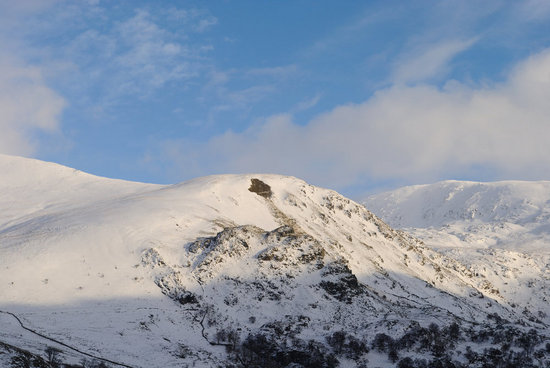
More snow than there looks, the view from the A5

The Carneddau tends to hold more snow than the Glyderau and Snowdon ranges

Looking towards the Northern Carneddau where there is often more snow than elsewhere

If it's been windy, has the snow been swept onto one side of the hills more than the other? - normally the case in Snowdonia but watch out for the avalanche conditions that come with this.

The spread of snow across Yr Elen and Carnedd Llewelyn, notice the lack of snow in some areas, particularly ridge lines, or the increase in snow in the gully between the two peaks.

You don't actually need that much snow to ski on, as when it's frozen the patches of grass between the snow ski quite well too!

Skiing the lines of snow between the grass, and the frozen grass too!

When you're out hiking in the summer look for slopes that are grassy underfoot as normally there is only enough snow to cover grass and not rocks and small boulders.

A variety of terrain in Snowdonia, some of which I had checked out in the summer months before hand

For the steep skiers amongst you have a look at a the winter climbing guidebooks for inspiration, grade one gullies can sometimes make great skiing.

The steeper lines here can provide great skiing in addition to climbing

Often conditions are better in the morning before it gets warmer, so go out and enjoy a dawn patrol

Setting a skin track before work in March

Stay safe and have fun

Keep smiling, it's not every day you get to ski in Snowdonia

Monday, 23 October 2017

IML Tree of the Month 3: Scots Pine

A Scots Pine above Loch Maree in Torridon
Sticking with the theme of coniferous trees, the third tree in my series is the Scots Pine.  One of only three conifers native to the UK and quite possibly my favourite tree (although I do love Cedar of Lebanons!)


Identification: 
Latin Name: Pinus Sylvestris

Height: up to 35m

Leaves: needle like, blue-green, slightly twisted, grow in pairs on short side shoots, 4-7cm long
scots pine needles
Woodland Trust

Flowers: Monoecious. Male flowers are clusters of yellow anthers at the base of shoots.  Female flowers are small, red purple, globular and grow at the tips of new shoots.

Fruits: Female flowers develop into egg shaped cones after wind pollination.  They mature the following season, meaning there are always cones of different ages on each tree.  Mature cones are grey brown with a raised circular bump at the centre of each scale.  Normally these are in clusters of 2-4 and they point backwards along the stem.

https://treesforlife.org.uk/forest/species-profiles/scots-pine/

Bark: Scaly orange brown, particularly at the top, when young it can be more of a grey green colour, develops plates and fissures with age

Woodland Trust

Twigs and buds: Twigs are grey-brown and hairless

Age: lives to 300 years, tends to lose it's lower branches as it ages

Pinus Sylvestris http://www.conifers.org/pi/pi/s/sylvestris01.jpg

Uses: 

  • Widely used in joinery and the construction industry.
  • Used in the manufacture of telegraph poles, gate posts, fencing
  • The tree can be tapped to make turpentine from its resin
  • Dry cones can used as kindling
  • Used for paper pulp


Fun Facts:


  • It's the National Tree of Scotland
  • One of the strongest softwoods available
  • Groups of pines growing along old droveways helped travellers to find where they were going in changing weather
  • A Scots pine in the forest of Muirward Wood, Perthshire, has the largest trunk in the UK.  It has a height of 31m and a girth of 6.09m
  • Until around 8000 years ago Scots Pine made up most of the pine forests in the UK, particularly in Scotland and North England
  • The most widely distributed conifer in the world, from sea level to 2400m
  • Need a high level of light to germinate and so do not often regenerate under their own canopy but rather seedlings are found in open areas and clearings.


This website has lots of really good facts about the Scots Pine's relationship with other things.